
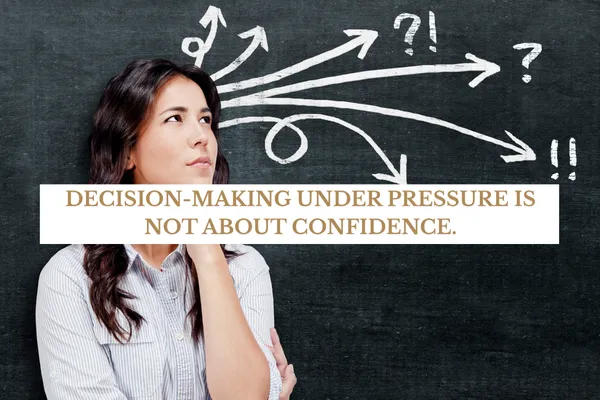
Decision-Making Under Pressure Is Not About Confidence. It Is About Structure.
I want to be clear here: You did not lose clarity. You lost the system that was supposed to hold it.
That is the part nobody tells you. High performers do not fall apart under pressure because they are weak or undisciplined. They fall apart because their decision process was never built to function under stress. It was built for calm. And calm does not last.
So when pressure arrives — a difficult conversation, a missed target, a decision with real consequences — the process collapses. You second-guess what you already knew. You reopen what you already decided. You feel busy and somehow still stuck.
This is not a confidence problem. Confidence is not what holds decisions together under pressure. Structure is.
Pressure Does Not Break You. It Shows You What Was Never There.
Here is what actually happens when pressure increases.
Time compresses. Stakes feel higher. Your emotional signals get louder and start competing with your judgment. And if you do not have a decision structure that was designed to operate under those conditions, you default.
You overanalyze what should be simple. You delay what is already clear. You reopen decisions you made three days ago. You tell yourself you need more information, more time, more certainty — and none of it arrives.
Execution does not slow down because you lost your direction. It slows because your system was never equipped to maintain direction when conditions changed.
That distinction matters more than most people realize.
The Pattern That Hides in Plain Sight
I work with leaders who perform at a high level inside structured environments and quietly unravel the moment that structure disappears.
During a normal work week, everything holds. Expectations are defined. There is external pressure keeping things in motion. Decisions get made because the environment demands it.
Then the structure drops. A slower period. A long weekend. A transition between phases. And something shifts in a way that is hard to explain but impossible to ignore.
Decisions that should take five minutes get postponed for days. Simple actions sit unresolved. The internal negotiation — the back and forth inside your own head — increases over things that genuinely do not warrant it.
From the outside, it looks like a discipline problem. It is not.
It is a dependency. The habit — often invisible — of using external pressure as a substitute for an internal decision system. When the pressure exists, you decide. When it does not, you wait for it to return.
The leaders who operate with real consistency are not more disciplined or more motivated. They have built a system that functions with or without external pressure, forcing the decision.
The Real Cost of Unfiltered Decisions
Most people blame decision fatigue on volume. Too many decisions, too little energy.
That is only part of it.
The deeper problem is that nothing is filtered. Everything arrives at the same level of importance. Everything competes for the same attention. Nothing is pre-decided. And so your cognitive capacity — which is finite, regardless of how capable you are — gets spent managing the noise instead of moving what matters.
You end the day exhausted and behind. Not because you executed too much. Because you spent your best mental energy on decisions that should never have reached you.
The solution is not more motivation. There are fewer decisions.
High-level operators build filters before pressure arrives. They define in advance what deserves their attention, what gets ignored without guilt, and what has already been decided and will not be revisited.
In practice, it looks like this:
If it does not move revenue or stability, it comes off the list
If it requires emotional energy and you are not in a regulated state, it waits
If the decision has already been made, it stays made
When those filters exist, clarity stabilizes. Not because the problems disappear. Because the system stops treating everything as equally urgent.
The Loop Is Not a Question. It Is a Pattern.
Here is the thing I have noticed working with high performers across different industries and levels of responsibility.
The problem is almost never logic. People know what they need to do. The problem is the loop.
"What if this is not the right move?" "What if I regret this later?" "What if I am missing something important?"
These feel like due diligence. They are not. They have learned to sound strategic.
Every loop reopens a decision you already made. Every reopening costs you time, energy, momentum, and — over time — trust in your own judgment. You feel like you are being careful. You are actually stuck in a pattern that is designed to feel productive while keeping you exactly where you are.
The work is not silencing the questions. It is learning to recognize the loop the moment it starts — and closing it before it takes another hour from you.
Timing Is a Decision Before the Decision
There is one more thing strong leaders understand that rarely gets discussed.
Not every decision belongs in the same category. Treating them as if they do is one of the most expensive habits in execution.
Some things need to move now. Some things belong on a calendar with a specific time assigned. Some things need to be removed from consideration entirely and never returned to.
The leaders who execute with the most consistency are not faster or more confident. They waste less time placing decisions in the wrong category. That is the real advantage — not talent, not discipline, not motivation.
Without that structure, you rush what needs stability and delay what needs to move. Both destroy momentum. Just in different ways, on different timelines.
What This Actually Comes Down To
The goal is not to become someone who never doubts. Doubt is not the enemy.
The goal is to build a system that does not depend on perfect conditions to function. One that holds when pressure increases, when structure drops, when clarity feels temporarily out of reach.
Because the leaders who execute at the highest level are not operating without friction. They have simply reduced the internal friction enough that it no longer controls the outcome.
That is the real work. Not confidence. Not motivation. Structure.
One question worth sitting with:
When pressure increases, do your decisions get clearer — or do they get harder to close?
If the answer is harder, your system needs attention before the next high-stakes moment arrives.
The Decision Clarity Planner is where that work starts. It is designed to help you identify exactly where your decision process breaks down and what to build in its place.
→ Take the Decision Clarity Planner
→ Or go deeper with the Decision Style & Execution Profile