
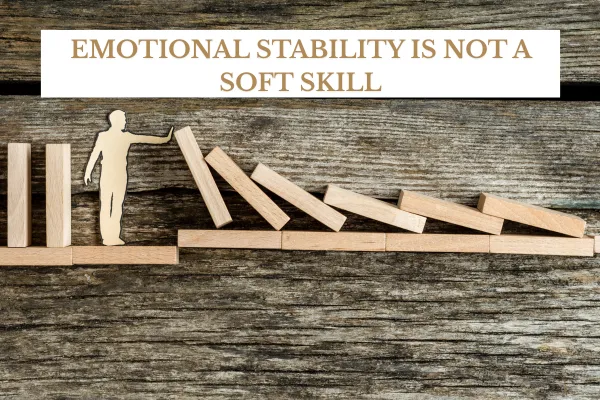
Emotional Stability Is Not a Soft Skill. It Is a Leadership Requirement.
It Is a Leadership Requirement.
Most professionals believe pressure reveals competence.
It does not.
Pressure exposes emotional structure.
Under stress, leaders do not rise to strategy.
They fall into their internal state.
Emotional stability is the ability to remain internally neutral while making high-impact decisions.
It is not calm.
It is not emotional suppression.
It is a regulation.
Pressure Reveals Emotional Structure
Leaders without emotional regulation react when they are supposed to act.
They speed up decisions.
Their narrow perception.
They confuse urgency with importance.
This creates execution noise. Execution noise erodes clarity and decision quality.
When emotional instability creates execution noise, decision clarity deteriorates. At this stage, a structured decision framework helps reduce internal friction and restore focus.
Stability Refines Intensity
Emotional stability does not reduce intensity.
It refines it.
Stable leaders read context with precision.
They observe without emotional interference.
They separate the signal from the noise.
They preserve decision quality under constraint.
Pressure remains present.
It no longer dictates judgment.
Neutrality Is Not Personality
This is not personality.
It is trained behaviour.
Stability is built through awareness, regulation, and repetition.
Over time, it becomes a deliberate response pattern rather than an emotional reflex.
Most professionals expand external responsibility before expanding internal capacity.
When role complexity grows faster than emotional structure, pressure exposes the gap.
Emotional Stability as Infrastructure
Emotional stability is not optional in leadership development. It is an operational infrastructure.
Leadership delivery reflects internal regulation.
Observable Effects of Instability
reactive decision-making
compressed timelines
narrowed perception
inconsistent execution
In high-responsibility roles, emotional structure defines the ceiling of execution quality.
Strategic Self-Leadership Diagnostic
Pressure exposes emotional structure and decision patterns. Understanding how you decide under stress is the first step toward stabilizing execution.