

Internal Consistency: The Executive Skill No One Trains
Behavioural Direction Defines Identity
You have not been inconsistent because you lack discipline. You have been inconsistent because you never built a system that works without it.
That is the distinction most people never reach. They keep trying harder. They recommit. They restart. And the results stay roughly the same — because the structure underneath never changed.
Talent is not the variable. Strategy is not the variable. The variable is whether your behaviour holds when conditions stop being ideal.
Almost no one trains that deliberately. Which is exactly why it separates the people who compound results over time from the people who keep beginning again.
The Myth of Emotional Stability
Before going further, one misconception is worth addressing directly.
When people picture a consistent leader, they imagine someone who does not feel much. Someone above the fluctuations of daily pressure, unaffected by doubt or difficulty. That is not stability. That is disconnection.
Consistent leaders feel everything. The difference is that they do not let what they feel redirect what they do.
Your mood will shift. Your energy will shift. Your motivation will shift. None of that is the problem.
The problem is when your direction shifts with it.
Consistency is behavioural. Not emotional. That distinction changes everything about how you approach the work.
The Drift Nobody Notices Until It Has Already Cost Them
Performance failures rarely arrive as a single event. They do not announce themselves. They accumulate.
It looks like this:
You revisit a decision that was already made
You delay execution, waiting for more clarity that is not coming
You skip a routine, just this once
You internally negotiate a standard that was supposed to be non-negotiable
You let how you feel in the moment override what you committed to before it
Each of these looks insignificant in isolation. That is precisely what makes it dangerous.
Repeated daily, these micro-decisions do not just affect your output. They redefine your identity. You do not lose performance in one dramatic collapse. You leak it through accumulated small inconsistencies — and by the time it is visible, the pattern is already established.
That is what makes behavioural drift so difficult to catch. And so expensive to ignore.
Repetition Before Motivation
Most professionals wait to feel aligned before they act. They wait for the right mood, the right focus, the right energy level. They are waiting for internal conditions to match the standard they want to perform at.
High-consistency professionals reverse that sequence entirely.
Action first. State follows.
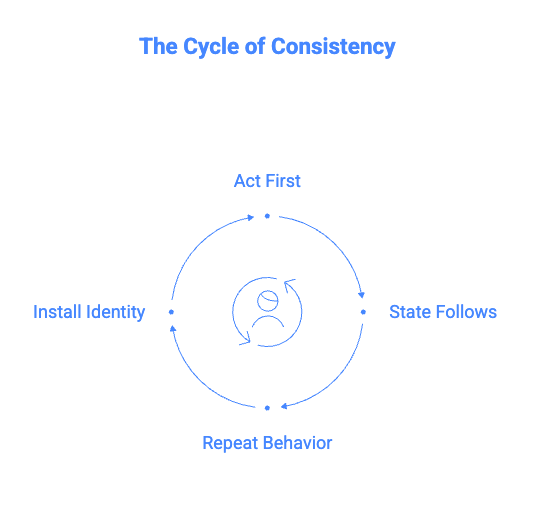
You do not become consistent because you feel stable. You become stable because you repeat aligned behaviour long enough that it stops requiring a decision. It becomes who you are.
Repetition is not discipline for its own sake. It is identity construction. And it only works in one direction — forward, regardless of how you feel today.
Your Default Failure Pattern Has a Shape
Every professional has one. Yours has likely appeared multiple times already. You may just not have named it yet.
For some people, it is overanalysis — the inability to close a decision and move. For others, it is urgency without prioritization, constant motion that produces very little direction. For others, it is emotional reactivity; the moment pressure increases, everything that was clear becomes negotiable.
The pattern is not random. It is consistent. Which means it is also interruptible.
But interrupting it does not require more motivation. It requires structural intervention — identifying the exact moment the drift begins, defining the precise behavioural correction, and installing that correction through daily repetition until the new pattern replaces the old one.
This is not motivational work. It is architectural work. The difference matters.
Direction Over Intensity
There is a specific type of professional I see stuck in the same place year after year despite enormous effort.
They execute in bursts. They restart with renewed energy. They re-strategize when results plateau. They expand before they have consolidated anything. And they are genuinely working hard, which is part of why the pattern is so frustrating to recognize.
Intensity feels like progress. It has the sensation of momentum. But intensity without direction is just sophisticated motion.
Consistency is not doing more. It is doing the same aligned behaviours long enough for them to compound. That is precisely where most leaders break their own systems — not from lack of effort, but from redirecting effort before the previous investment had time to return anything.
Identity Is Demonstrated, Not Declared
Here is the part that is uncomfortable but necessary.
If your decisions shift weekly, your identity shifts weekly. If your standards fluctuate with your emotional state, your authority erodes — internally first, then externally.
Internal consistency is the alignment between three things:
What you say your priorities are
What your daily behaviour actually reflects
How you respond when pressure tests both of those
When those three stabilize, identity solidifies. Not because you declared it. Because you demonstrated it — repeatedly, under conditions that gave you every reason not to.
That is executive maturity. And it cannot be shortcut.
Why Willpower Always Fails at the Wrong Moment
Most people try to solve consistency with willpower. And it works — right up until it does not.
The problem is structural. Willpower is finite. It depletes under pressure, which is precisely when you need it most. You are asking a limited resource to perform at its peak exactly when conditions are working against it.
Structure does not have that problem.
When direction is defined in advance — clear priorities, established behavioural standards, pre-committed non-negotiables, a daily review that keeps the system honest — emotion loses its authority over behaviour. Not because you suppressed the emotion. Because the decision was already made before the emotion arrived.
That is how consistency becomes sustainable. Not through greater effort. Through better architecture.
The Real Differentiator
The next level of leadership does not require more insight. Most people already have more insight than they are currently acting on.
It requires behavioural stability — the kind that holds under pressure, survives disruption, and compounds over time without needing to be rebuilt from scratch every few months.
Internal consistency is the executive skill that no formal training addresses directly. Yet it is the one that determines who builds durable results and who stays locked in cycles of starting over.
You do not need more ambition. You need disciplined repetition aligned with a direction you have actually committed to.
That is how identity becomes something you can rely on.
Three questions worth sitting with before you move on:
Where does your behaviour drift when pressure increases?
What pattern shows up repeatedly when things get difficult?
What decision have you been revisiting instead of executing?
Consistency does not begin with motivation. It begins where internal negotiation ends.
If you want to see your behavioural patterns under pressure with clarity — not as a concept, but as a specific map of where your system breaks down — that is exactly what the Self-Leadership Blueprint Quiz is designed to surface.
→Take the Self-Leadership Blueprint Quiz.
→ Or explore the full framework inside the Decision Style & Execution Profile