
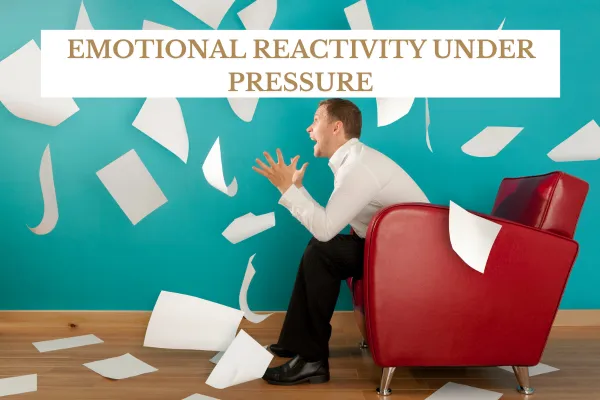
Emotional Reactivity Under Pressure: How Leadership Styles Lose Stability
How Leadership Styles Lose Stability
Pressure affects leaders differently. Emotional reactivity follows predictable patterns.
Your leadership style determines how you process pressure internally. When emotional regulation weakens, each style expresses instability in specific ways.
This article shows how emotional reactivity appears across leadership profiles. Emotional stability is a trained competency, not a personality trait.
Why Emotional Reactivity Is Style-Specific
Emotional reactivity is not random. It follows your internal preferences for control, speed, connection, or reflection.
Under pressure, you default to familiar patterns. Without regulation, those patterns distort decision quality.
Understanding your style-specific reactivity is the first step toward stability.
How the Four Leadership Profiles React Under Pressure
Achiever Profile
Achievers respond to pressure by accelerating.
They increase intensity, compress timelines, and override signals of overload.
Common instability patterns:
• urgency bias
• control escalation
• reduced listening
• execution without recalibration
Without regulation, speed replaces clarity.
Innovator Profile
Innovators respond to pressure by shifting focus.
They generate alternatives instead of committing to decisions.
Common instability patterns:
• over-ideation
• decision avoidance
• scattered execution
• loss of prioritization
Without regulation, creativity replaces delivery.
Connector Profile
Connectors respond to pressure by absorbing emotional context.
They prioritize harmony over decision boundaries.
Common instability patterns:
• people-pleasing
• delayed decisions
• emotional leakage
• avoidance of necessary tension
Without regulation, connection replaces leadership clarity.
Reflector Profile
Reflectors respond to pressure by withdrawing internally.
They analyze instead of acting.
Common instability patterns:
• over-analysis
• delayed execution
• internalized stress
• loss of momentum
Without regulation, reflection replaces movement.
These reactivity patterns are consistent and measurable. Mapping your decision style under pressure clarifies what needs to be stabilized.
Decision Style & Execution Profile
Why Emotional Stability Equalizes Leadership Performance
Emotional stability does not erase style differences.
It stabilizes them.
Regulated leaders:
• maintain clarity under pressure
• separate emotion from signal
• preserve decision standards
• execute without distortion
This principle is foundational in Emotional Stability as a Leadership Requirement
Strategic Self-Leadership Diagnostic
To identify your dominant emotional pattern under pressure, take the Strategic Self-Leadership Diagnostic