
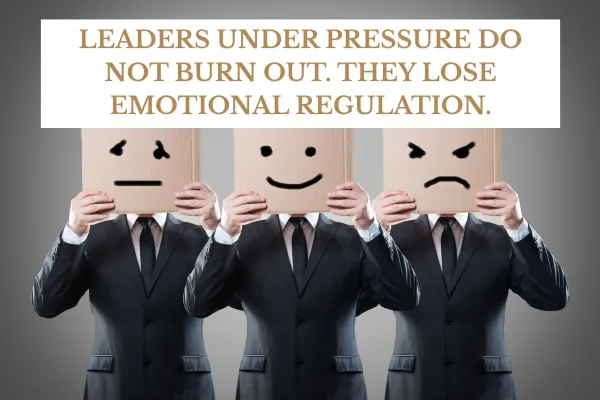
Leaders Under Pressure Do Not Burn Out. They Lose Emotional Regulation.
Leaders Under Pressure Do Not Burn Out. They Lose Emotional Regulation.
Pressure is not the enemy of leadership. Unregulated pressure is.
High-responsibility roles demand sustained intensity. What breaks leaders is not workload, visibility, or expectations. It is the loss of emotional regulation under continuous pressure.
When regulation fails, you do not slow down. You destabilize.
This article explains how pressure erodes execution through emotional instability and why emotional regulation is a core leadership requirement.
Why Pressure Does Not Cause Burnout
Burnout is often misdiagnosed. Pressure alone does not cause collapse.
You break down when:
Emotional load exceeds regulation capacity
Decisions are made from tension instead of standards
Urgency becomes the default operating state
Without regulation, pressure accumulates internally. Execution begins to leak quality.
How Emotional Instability Shows Up Under Pressure
Loss of emotional stability follows a predictable pattern.
Under pressure, you begin to:
React faster than you think
Compress timelines unnecessarily
Reduce listening and context scanning
Rely on urgency to maintain momentum
This creates short-term movement and long-term erosion.
These patterns connect directly to the instability described in Emotional Stability as a Leadership Requirement.
Pressure Exposes Profile-Specific Weaknesses
Pressure does not create new behaviours. It amplifies existing patterns.
Achievers escalate speed. Innovators scatter focus. Connectors absorb emotional noise. Reflectors delay execution.
These patterns were mapped in Emotional Reactivity Under Pressure and refined through profile-specific regulation in Why Emotional Stability Looks Different Across Leadership Profiles.
Without regulation, your style becomes a liability.
Why You Lose Regulation Before You Notice
Loss of regulation rarely feels like instability. It feels like responsibility.
Common signals you ignore:
Constant urgency
Emotional fatigue masked as productivity
Reduced decision confidence
Increased irritation or withdrawal
These are early indicators of internal overload.
When ignored, they compromise execution quality and leadership presence.
Rebuilding Regulation While Staying under Pressure
You do not need less pressure. You need stronger regulation.
Effective leaders:
Regulate internal state before deciding
Apply decision standards under stress
Stabilize execution rhythm
Separate the emotional signal from the strategic signal
This approach aligns with the internal recalibration process outlined in Clarity & Identity Reset
Sustained pressure requires sustained structure. Long-term leadership stability is built through guided execution alignment. Premium Coaching Programs
Strategic Self-Leadership Diagnostic
To identify how pressure affects your emotional regulation and decision quality, take the Strategic Self-Leadership Diagnostic.